Contents
More and more video models generate sound together with the picture: lines of dialogue with lip movement, footsteps, clinking dishes, rain and background music. But the model only hears what you wrote. If the sound isn't described, it guesses on its own, and if it's described carelessly, it mixes up who's speaking and what's making the noise.
Below we'll look at which models can do sound according to their official documentation, how they handle languages, and how to write dialogue, effects, ambience and music.
Which models generate sound
The table is based on the developers' documentation as of the check date. In Solistra, you can see whether a model has sound on its card and in its run form.
| Model | What it voices | Speech languages per documentation |
|---|---|---|
| Veo 3.1 | Dialogue, effects, ambience. Sound is always on | English fully, other languages not tested |
| Kling 2.6 | Voice, dialogue, singing and rap, ambience, effects | Chinese and English, others are translated into English |
| Kling 3.0 | The same plus several speakers, dialects and accents | Chinese, English, Japanese, Korean, Spanish |
| Kling 4.0 | Stereo sound, lip sync | Adds Portuguese, German, French, Hindi and others |
| Seedance 1.5 pro, 2.0, 2.5 | Voice, effects and background music, mono sound | Not specified for speech |
| Wan 2.5 and later, Wan 3.0 | Dialogue, background music, effects | Wan 3.0 prompts in Chinese and English |
| Grok Imagine 1.5 and Lite | Sound by default, speech with lip sync | Not specified |
| MiniMax H3 | Stereo sound, with voice, effects and music modeled together | Not specified |
Hailuo 2.3's API reference doesn't mention sound. Kling, Seedance and Grok Imagine let you turn sound off if you need a silent clip for your own music. Veo 3.1 always has it on.
Speech in Russian
None of the documentation we checked lists Russian among the speech languages. Kling states plainly that lines in an unsupported language are translated into English. Google notes that languages other than English haven't been tested and results may vary.
What to do in practice:
- If a Russian line matters, try it short and check the result. Be prepared for the model to say it with an accent, translate it or garble it.
- For reliability, write the line in English or another language from the model's list.
- Build the clip on effects and music without speech, and record the voice separately.
How to write dialogue
All the guides agree on the main thing: the text of the line goes in quotes, and right next to it, it's clear who is speaking and how.
- A speaker label. The same name throughout the prompt: [Barista], [Guest]. No "he" or "she". Kling's 2.6 guide calls this the first rule of dialogue, and Alibaba repeats it for Wan.
- Action first, then the line. "The barista sets a cup on the counter. [Barista, cheerfully]: "...". " That way the model ties the voice to the right person.
- A voice description. Emotion, pace, timbre, accent: "a low husky voice, slowly", "bright and fast".
- Links between lines. "Right after that", "in reply". Otherwise two lines can merge into one voice.
- Time for speech. Kling recommends 10-second clips for dialogue and singing. A short scene fits one or two phrases.
According to Alibaba's guide, Wan 3.0 expects the format "character, speech verb, colon and the text in quotes". If there should be no speech, write "no dialogue", or the model will decide for itself. In the Seedance API, ByteDance also advises putting lines in double quotes.
How to write effects and ambience
Kling offers simple formulas.
- A sound effect: source, action and sound. "A wooden door slams shut with a dull thud."
- Ambience: place, sound elements and space. "Rain on a tin roof, distant thunder, the hollow echo of an empty hangar."
Google advises describing sound in separate sentences without mixing it with the picture. The Wan guide notes that the model adds effects on its own if the action and the material are described clearly: a flapping flag, footsteps through puddles, visible breath in the cold.
Music
- Description. Instrument, genre, mood: "piano, jazz, melancholy".
- Three levels in Wan. Write nothing and trust the model, describe the music in detail, or forbid it outright.
- Forbidding music. Kling 4.0 considers "no background music" one of the few truly useful negative instructions, because the model may add music by default.
- Tags in Seedance 2.5. The guide suggests marking music with parentheses, effects with angle brackets, dialogue with curly braces and subtitles with square brackets. Plain text works too.
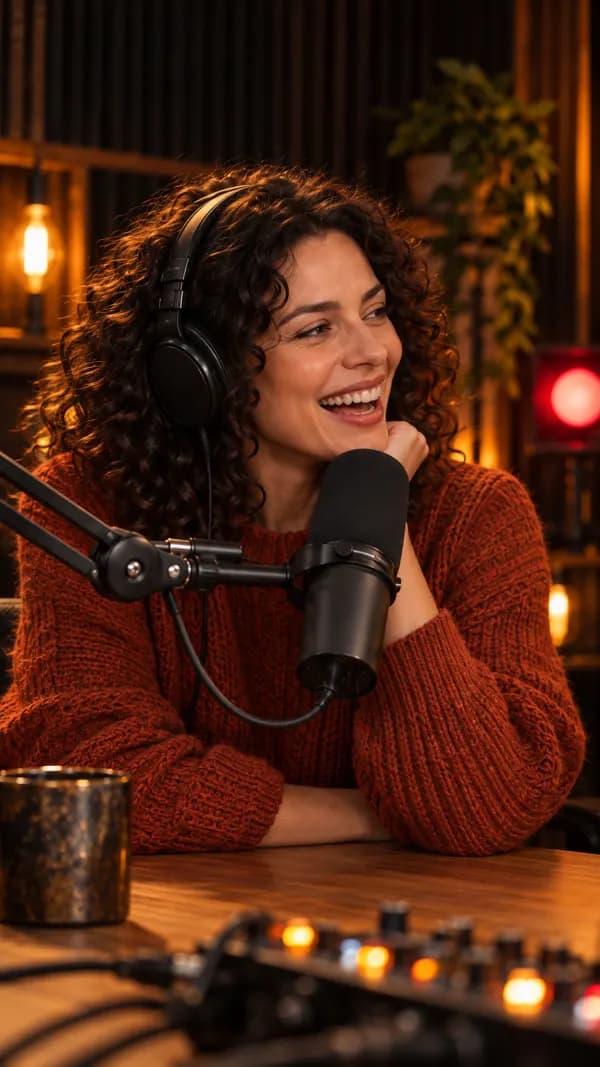
Prompt examples
A barista in a black apron pours steamed milk into a cup and draws a heart in the foam. Close-up of the hands. Sound: the hiss of the steam wand, a soft splash of milk, a spoon clinking on a saucer. Muffled cafe chatter in the background. No background music.
A kitchen at night, lit only by the lamp over the stove. [Mom] sets a bowl of soup in front of her son. [Mom, softly and warmly]: "eat while it's hot". Right after that, [Son, tired voice] looks up and smiles. [Son]: "thanks, mom". Medium shot, static camera. In the background, a clock ticks and the fridge hums.
A slow flight over an autumn forest in morning fog. A male voiceover, calm and unhurried: "every autumn the forest starts a new story". Sound: wind in the treetops, distant calls of cranes. Quiet music: cello and piano, melancholic.
An empty bus stop at night in heavy rain, a streetlight flickering. Water runs off the shelter roof in thin streams. Static camera. Sound: heavy drops on the plastic roof, tires on wet asphalt in the distance, the hum of the streetlight. No dialogue, no music.
A young woman with short hair sits on a tall stool in a small club in blue light, playing an acoustic guitar. She sings in a soft, warm voice: "stay with me until the morning light". The audience is in shadow. Sound: guitar, a light clink of glasses. A 10-second clip, the camera slowly circling her.
Close-up: a can of soda on ice, condensation running down the metal. A hand opens the can. Sound: a sharp click and the hiss of gas, then ice clinking. Right after that, quiet rhythmic electronic music. Bright cool light.
Common mistakes
- A line with no quotes and no label. The model doesn't understand that it's speech or who says it. Quotes and the character's name are a must.
- Pronouns instead of names. "He said... and she replied" in a scene with two people mixes up the voices.
- Sound in the same sentence as the picture. Describe sound in separate sentences.
- Music nobody asked for. If you need silence or your own music, write "no background music", or the model may add some.
- An unexpected voice. In Wan, the model decides on its own whether speech is needed if you didn't write "no dialogue".
- A long monologue in 5 seconds. The phrase won't fit and will get cut off. Shorten the line or increase the length.
- Russian dialogue text left unchecked. The documentation doesn't promise Russian speech. Check the result or pick a supported language.
How to try it in Solistra
Open Seedance 1.5 Pro in Video («Видео») and paste a prompt with sound. For dialogue with several characters, try Kling 3.0, and for longer clips with sound, Wan 3.0. The cost shows on the run button before you press it.
Read more about sound in specific models in the guides to Kling, to Veo, to Seedance and to Wan.
Try it in Solistra
Seedance 1.5 Pro
Video
Similar models
Sources and licenses
- Generating video with Veo 3.1 — audio prompts — Google — CC BY 4.0
- Video generation prompt guide — Audio section — Google Cloud — CC BY 4.0
- Kling VIDEO 2.6 — audio in video — Kuaishou, Kling AI
- Kling VIDEO 3.0 — user guide — Kuaishou, Kling AI
- Kling 4.0 — user guide — Kuaishou, Kling AI
- Create a video generation task — audio in Seedance — BytePlus ModelArk, ByteDance
- Seedance 2.5 — prompt writing guide — ByteDance
- Wan 3.0 — prompt guide — Alibaba Cloud Model Studio
- Video Generation — audio in Grok Imagine — xAI
- MiniMax H3 — model announcement — MiniMax
- Text
- Solistra text. Our own wording and prompt examples, quotes under 15 words
- Images
Other images — Solistra image
- Checked
- November 12, 2026